
Start by sorting your products by job. A cleanser comes first when you wash. If you use a prescribed treatment, follow the instructions you received from your clinician. Moisturizer and sunscreen come after the appropriate earlier steps, with makeup afterward if you wear it. Your sunscreen directions still determine how and when you use that product.
Write down the steps you already use
Put the bottles on the counter and read their directions before choosing their places. If your morning routine has cleanser, moisturizer, sunscreen, and makeup, write that as a short list. If you have a treatment with special timing or placement, copy the actual directions beside the list. A neat lineup of bottles is useful only when it helps you follow the instructions that apply to them.
The short answer for an ordinary morning
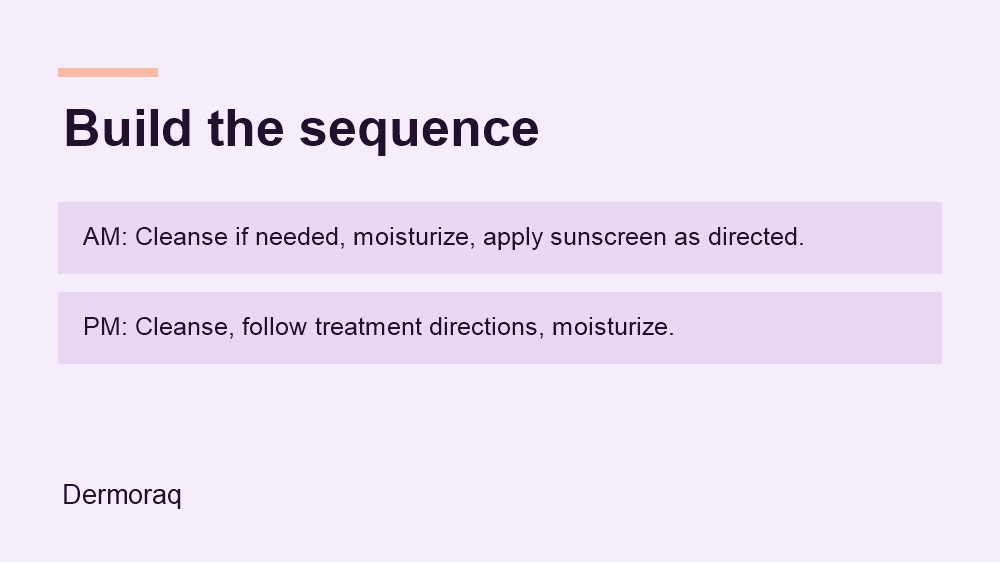
Wash or rinse gently as needed. If you use a treatment, follow its specific directions, paying attention to when and where it goes. Use moisturizer if you need it. Apply sunscreen according to its label before outdoor exposure. If you wear makeup, apply it after the sunscreen step. This is a useful order for a basic routine, and the American Academy of Dermatology describes a similar sequence. Any product-specific directions or instructions from your clinician take priority over a general list.
An evening routine has a different job. Wash gently to remove the day’s buildup and follow the directions for any evening treatment. Apply moisturizer as needed. If makeup or a long-wear product requires a particular removal method, use it as directed before moving to products meant to stay on your skin. A short evening routine can be sufficient even if you used more products before you left home that morning.
Cleansing comes before products you mean to leave on
A wash is easier to place when you think about what it removes. If you apply a moisturizer and then wash it away, you have added a step without getting the timing you meant to use. When you are washing, start there. Use lukewarm water and a gentle touch. If your face feels comfortable when you wake up, a rinse may be enough. A cleanser can be useful later in the day when you want to remove the products you wore outdoors or at work.
Keep removal and everyday cleansing in the same part of the sequence. A makeup remover might have instructions for use before rinsing or washing. Read the makeup and remover directions, especially around the eyes, and follow them. When visible residue remains, check which product it is before you repeat a wash or rub in the same area. The order should help you remove what needs to come off, then move on to what needs to stay.
Put treatment directions where you can see them
If you use a treatment, read its instructions before you decide what goes immediately before or after it. Some instructions apply to a specific time of day, a particular part of your face, or skin in a certain condition. A general rule that treatment comes after cleansing cannot answer all of those questions. If you have instructions from a prescriber, follow them and ask that clinician or a pharmacist about anything that is unclear. Resist the temptation to change a prescribed step to match a routine you saw on a video.
Write the treatment instructions next to the step they apply to. Your note might include the time of day, the area, and any directions about other products. If two instructions seem to conflict, do not guess which one matters. Show both labels or directions to a pharmacist or the healthcare professional who gave you the treatment. Until you have an answer, avoid adding optional layers that make the routine harder to interpret.
Moisturizer is a step with a purpose
Place moisturizer where it can do the job you want. If you need comfort after washing, the AAD advises applying moisturizer while skin is still slightly damp. Check your product directions and any treatment timing before making that your default. If you use a moisturizer mainly on dry areas, you may not need to apply it everywhere. Keep track of which areas feel different after washing and later in the day.
If you dislike the feel of a moisturizer under sunscreen or makeup, identify which part of the combination feels wrong. Maybe it is comfortable at bedtime but feels sticky on your forehead in the morning. Consider leaving the optional moisturizer off a comfortable area or trying a lighter texture. Continue to use sunscreen as directed. A change that leaves you using less sunscreen than its label specifies does not solve the original problem.
Sunscreen deserves its own instructions
Use the sunscreen label to decide how to apply it, how far ahead of outdoor exposure it goes, and when to reapply. A general order chart can show sunscreen after moisturizer, but it cannot tell you the reapplication instructions for the product in your hand. Read the warnings and check how directions change for swimming, sweating, or towel drying. A hat, protective clothing, and shade also belong in an outdoor plan.
For a moisturizer that doubles as sunscreen, read the directions the same way you would with a stand-alone sunscreen. If you usually dab moisturizer on your cheeks, think about what it would take to use the combination according to its sunscreen directions on exposed areas. If the two jobs are easier for you to do separately, you can use two products. If you prefer one, choose and apply it based on the protection and directions you need.
Makeup generally follows sunscreen in the AAD’s routine sequence. If you are wondering whether a particular makeup product supplies enough coverage by itself, read its label and application instructions. A cosmetic finish and the amount needed to follow sunscreen directions are separate considerations. Use shade and other protective measures, and make a plan for reapplication if you are out for long periods.
Set up an order for three ordinary days
On a commute day, place the products in the order you expect to use them near the sink. After a rinse or gentle wash, use moisturizer if needed and apply sunscreen according to its directions. Put the labeled sunscreen in your bag if you will be outside later. You can get ready without adding a step whose purpose is unclear. If you wear makeup, put it somewhere you will see it after the sunscreen rather than reaching for it while you are deciding what comes next.
On an evening when you wore makeup, start with the removal method that fits the products you wore. A second cleanser is useful only if there is a reason to use it. If you already cleaned the area gently and removed the residue, you can move on. Use an evening treatment if directed, then use moisturizer where you need it. If a prescribed product has its own timing, arrange the routine around those instructions.
On a day outdoors with exercise or swimming, the morning order might feel familiar, but plan beyond the bathroom. Put sunscreen where you can reach it after activity and bring shade or clothing options as appropriate. Read the label when you are getting ready so you know which directions apply after swimming, sweating, or towel drying. The order of your morning products does not replace the decisions you will make later in the day.
Introduce an optional product only when the basic sequence is clear
Before adding a serum or primer, ask what it will do and where the directions say it belongs. A smooth shelf arrangement does not make a product necessary. Keep the steps you are already using steady when practical. If the optional product is comfortable and does something you value, you can decide whether it earns a regular place. If it makes the sequence harder to repeat, it may be easier to leave it out.
Read the directions on every product involved. Some people like to sort bottles by texture, but a rule based on light or heavy textures cannot answer questions about a treatment or sunscreen label. You may be able to order some cosmetics by the way they feel, as long as you follow directions. For example, if you add makeup, compare how it sits when you apply it after sunscreen as part of the usual routine. Do not keep changing the position of sunscreen just to improve the finish.
When layers roll up, compare one optional step
If you notice small rolls or crumbs on the surface, identify when they start. Is it while you spread moisturizer, while you put on sunscreen, or when you apply makeup over it? Compare a similar morning with one optional item left out. Keep following the sunscreen label. Write down what stayed the same and where the result differed. The point is to find a comfortable routine rather than make a broad claim about which ingredients are compatible.
If a product causes an ongoing rash or burning, stop using the suspected product and seek clinical advice if symptoms persist or worsen. Keep a record of the product names, where you used them, and when the symptoms appeared. If a prescribed treatment is involved, contact the prescriber or pharmacist for directions. Do not try to solve irritation by rearranging several products and continuing to use all of them.
Keep a routine card you can update
Write AM and PM on two lines. Under each one, put the steps you use most often. Leave space for a treatment instruction or a reminder to read the sunscreen directions. Keep the card near the products or on your phone. When you change a product, update the relevant step and check the new label. A familiar name can have more than one version, and a new format can have different instructions.
For example, you might write “AM: rinse if needed, moisturizer on cheeks, sunscreen as directed before leaving, makeup if wanted.” For night, you might write “remove makeup as directed, gentle wash, follow treatment instructions, moisturize.” Write what you actually do rather than copying an ideal list that has nothing to do with your schedule. If you are still working out a step, give yourself one question to answer next time.
The card can also help you pack. On a short trip, you might take the same basic cleanser, moisturizer, and sunscreen and leave optional products at home. Keep the packages labeled and readable. If a prescribed product goes in a separate bag, take the directions with it. Those details matter more than bringing along an item just because it sits beside the others at home.
If you share a sink, it may help to put the products you use in a small tray with the labels facing up. Keep prescription instructions where you can read them, and keep the sunscreen package intact. If you use some products only on certain days, store those separately so that you can distinguish the usual routine from an optional or occasional step. At the end of a week, review whether anything on the card was consistently skipped. Move a necessary step to a more convenient moment if directions allow, or remove a cosmetic step that you no longer want.
Questions to check against your label
Does moisturizer always go before sunscreen? That is a common arrangement in a simple morning routine. Check both products and follow their directions. If the sunscreen also serves as your moisturizer, make sure you can apply and reapply it as the sunscreen label requires.
What if I want to wash again after exercise? Follow a gentle washing routine after heavy sweating as recommended by the AAD. For outdoor activity, plan for sun protection before you go out and read the sunscreen directions for after sweating. Think about the morning wash and the workout as part of your real day, not as separate checklists that both have to contain every step.
Do I need an extra step between a cleanser and moisturizer? A basic routine often has no reason for one. If a treatment belongs there, follow the directions you have been given. If the step is an optional cosmetic, decide what it adds before making it part of every morning and evening.
Can I apply products in the same order in every season? Keep the order that matches the directions. Change the products or optional steps when your needs change. In hot weather you might prefer a lighter finish. In dry weather you might use moisturizer more often on one area. Keep sunscreen instructions and prescribed treatment directions in view when making those choices.
Check the order the next time you reach for the products
Start with what needs to come off, then follow the specific instructions for what stays on. If you can read each label, tell what job each item does, and repeat the sequence on a busy day, your order is useful. If you cannot say why a bottle belongs where it does, leave it out if it is optional or check the instructions if it has an important role. A short written routine gives you a place to start without guessing each morning.
AAD: Applying skincare products in order